Technical information

construction

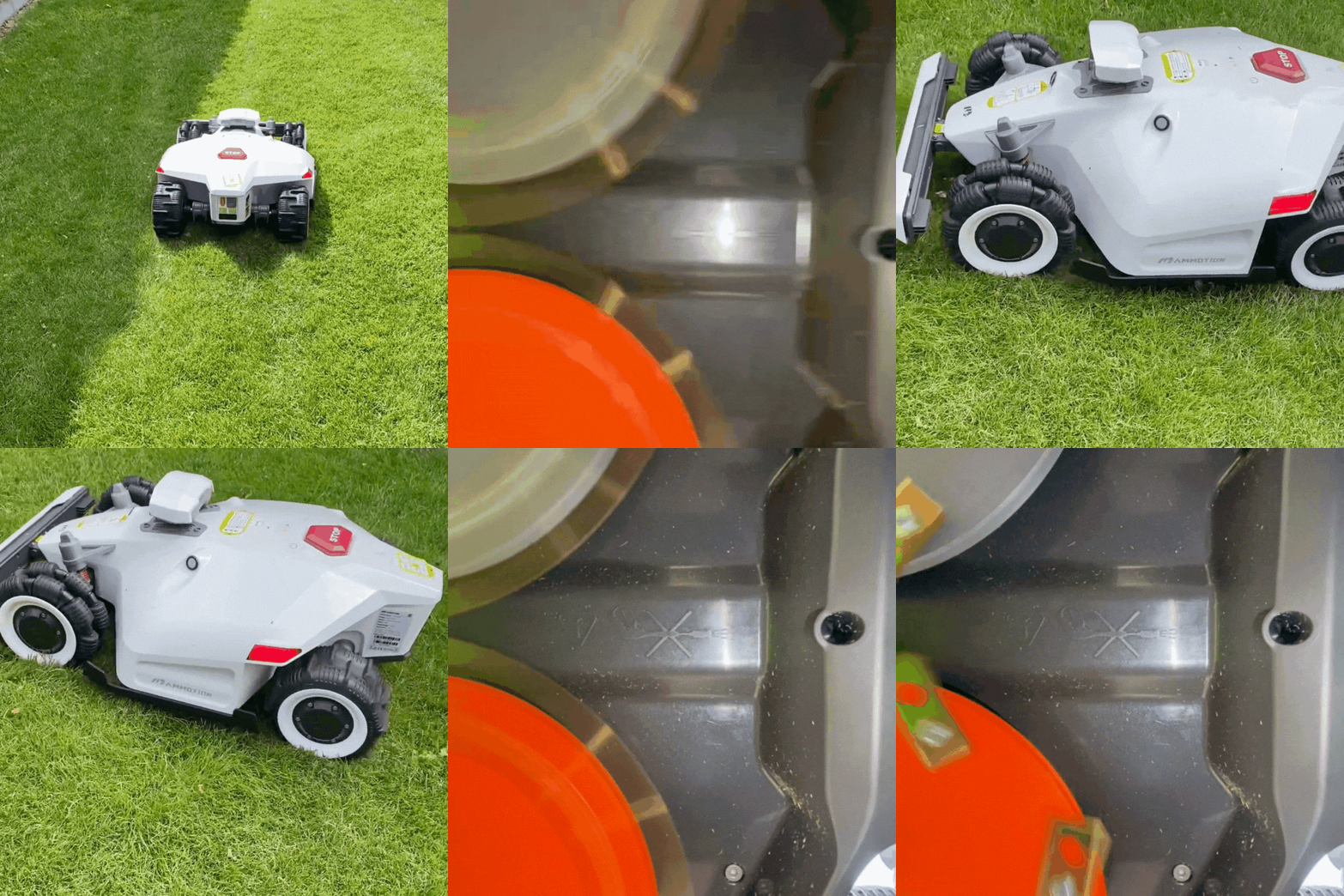
When developing the blade discs, the aim was to achieve a weight-optimized design with greater stability and also to reduce noise emissions and the tendency to become dirty. The smooth surface without edges means that less grass clippings can accumulate, which could potentially lead to imbalance.

Material properties

The knife plates are made from technical, thermoplastic material using the additive FDM printing process. When selecting the material, attention was paid to high mechanical strength as well as UV and weather resistance.

Increase cutting performance

The higher number of blades means that even very dense grass can be cut precisely and easily. The likelihood of plucking and the associated yellow blades of grass is reduced and the cut is more even.

Knife life

The service life of the knives is increased by the longer blade length available for cutting due to the larger number of knives. The knives are attached in such a way that they can usually be turned over and used again thanks to the optimized hole circle diameter.

Assembly

As with the original, installation is straightforward and possible without an adapter.

sustainability

The energy required for production is mainly provided by self-produced electricity. The filament is manufactured in Austria.

Attaching the knife blades

Brass threaded inserts ensure secure fastening of the blades using M4 screws.

compatibility

The conventional M4 screws and the original blades can continue to be used.

The cutting heights are exactly the same as those of the original blade disc.

Luba Messerscheibe mit 7 Messer Tuning in der Farbe anthrazit mit Adapter um 5 mm tiefer zu schneiden

Mammotion Luba

Luba mini Verbesserungen und Zubehör

Luba Mini

Mammotion Yuka

Mammotion Yuka

Yuka Mini tuning Messerteller

Yuka Mini

FAQs

The decision to use an odd number of blades is based on engineering principles derived from aircraft and mechanical engineering in order to minimize resonance frequencies. Symmetrically opposed blades can induce resonance phenomena, while odd numbers help to distribute the resulting forces and vibrations more homogeneously. Furthermore, the probability of imbalance, which can be caused by adhesion of grass clippings, is reduced with an odd number of blades.

This assumption is an overgeneralization. The robustness of 3D printing

starts with the careful selection of the material. A blade disc made

of high-impact polymers such as ASA can also withstand high loads, such as

contact with solid objects, and still exhibit adequate impact resistance. The

rotational speed of approximately 3000 revolutions per minute leads to

sudden obstacles to significant forces that are proportional

to the mass of the rotating components, so it

is crucial to choose the right material to absorb these forces

.

In particular, impact strength is an important property for materials used in outdoor applications such as mower decks

. ASA is known for its good impact resistance, even at low temperatures. Compared to other

plastics such as PLA, PETG and ABS, ASA offers the following advantages in terms of

impact resistance:

These properties

make ASA a preferred material for applications that require high

impact resistance, such as in the automotive industry, in

construction or sports equipment that is exposed to frequent knocks and bumps.

ASA's ability to maintain its integrity and performance under these conditions

makes it an excellent choice for outdoor use.

Innovative

design possibilities through 3D printing:

3D printing

is revolutionizing manufacturing technology through its ability to create complex structures

that would not be possible with traditional methods such as injection molding.

A significant advantage of this technology is the possibility, through

targeted design and the use of finite element methods (FEM),

to realize highly stable structures while saving on materials and weight

.

Material economy

and structural integrity:

An illustrative

example of the principle of material economy is the comparison between a

I-beam and a solid rectangular beam. The

I-beam, known in the construction industry for its high flexural rigidity and

load-bearing capacity, uses the material more efficiently by concentrating the mass

where it contributes most to the load-bearing capacity – far from

from the neutral fiber. This principle can be transferred to 3D printing,

where the integration of cavities and specific wall thicknesses can optimize the mechanical

properties.

FEM analysis

for optimization:

FEM analysis

supports this process by simulating the load-bearing capacity and behavior of the

structures under load conditions in order to adapt the design accordingly

. This results in components that offer high

strength and stability at a reduced weight. The ability to use cavities in a targeted manner

makes it possible to create lightweight yet highly stable structures that are

suitable for demanding applications.

Summary of

the advantages:

In summary,

3D printing offers the advantage over injection molding that it

integration of cavities and the application of FEM analyses,

high structural stability with optimized material use. This

leads to lightweight but extremely resilient components that are designed for demanding

applications. 3D printing uses the principle of

material economy, similar to an I-beam, to achieve

higher resilience with less material.

Rigid blades pose risks, especially for low material thicknesses

(under 0.5 mm). They can break on contact with solid objects and act as

dangerous projectiles. The direct power transmission to the drive and

bearing on impact can cause damage and increased wear, which

shortens the lifespan of the mowing robot. In contrast, pivoting blades

reduce the impact forces and are better suited to most lawns

.

Multiple blades improve the cutting pattern and mulching effect as they cut the lawn more finely. The load is distributed over more blades, which extends their service life. Physically, the arrangement of the blades at the edge of the mower disc increases the moment of inertia, resulting in a more stable rotational movement and less interference. For dense lawns or deep cuts, a higher number of blades may be necessary to ensure a uniform cutting pattern.